To help give us game ideas for our second game jam, we have been asked to research two different kinds of systems. One that is of culture or society and another that is technical or aesthetic.
Gross National Happiness (GNH)
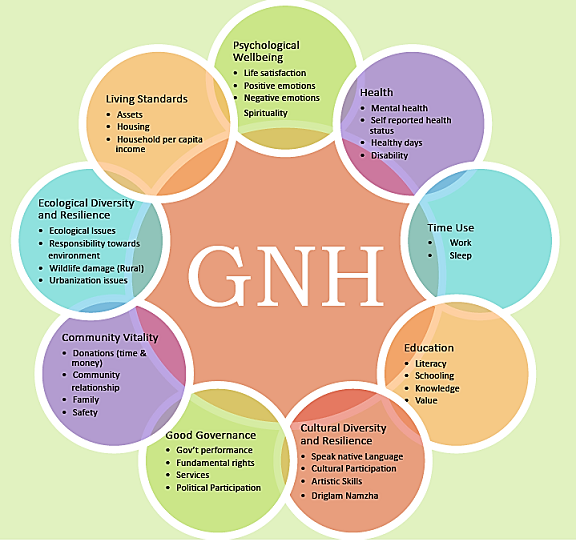
For the culture or society system I decided immediately to use Bhutan’s Gross National Happiness which is a system introduced by the king of Bhutan back in the 1972, suggesting that progress should be measured and paved via happiness rather than with economy. This system was divided into 9 different categories so that making policies around happiness is possible (‘Bhutan’s Gross National Happiness Index’. 2021).
a diagram of GNH is shown below in fig 1.
The system works by a happiness value if, an area is reported to have 50% or less happiness then they will receive benefits to ensure that those values increase. Depending on how well the system works it’s been recorded that only 10.4% of the country are under 50% happiness while 48.7% are between 55 – 65% happiness (narrowly happy) with 32.6% scoring up to 67 to 76% in happiness (very happy) and the remaining 8.3% having 77% in happiness.
Reflecting on why I chose this system, to me it’s a very unique system especially since most other countries use Gross Domestic Product (GDP), a system that measure how much money is being made and spent to determine the well being of a country (‘What is GDP?’. 2021). In addition, reading further into the why of the system it’s made clear that the king at the time cared about the well being of his people which adds a wholesome feeling to the system.
This is a similar feeling I hope to capture in the game jam as it could also get the player to learn something new about the world and how money isn’t the only thing to indicate well being. This, of course, depends on how much the style of the game is made to look like Bhutan’s culture and if whether or not the player believe GNH is an actual thing.
Procedural Content Generation (PCG)
The technical system I researched was Procedural Content Generation as it is a very interesting system that can be used as a mechanic or tool to make unique features/content with or without the designers input. This type of system is has s tendency to be used if the team consists mainly of programmers rather than artist and designs. This is one of the reasons I find this system interesting as it can be used to generate content at a near infinite possibility just by adjust its parameters to make game dev easier. The system also uses random values to ensure that each bit of content is unique (N. Yannakakis and Togelius 2018).
The type of PCG that I want to make is similar to Left4Dead’s (Value Corporation, 2008, PC) zombie system that would increase or decrease the amount of zombies in the game depending on the player’s progress. The proper name for this type of PCG system is called ‘Experience-Driven PCG’ and is used to adjust the pace of the game based on a value/model representing the player’s stress or other emotions, the pace in this case could be the design of the level, number of enemies or the type of weapons you will be given (N. Yannakakis and Togelius 2018). A diagram of experience-drive PCG can be show below in fig 2.

One of the problems that I would be facing is that, due to the randomness of PCG it can be hard to control the output of the system and thus affect the type of experience the game is trying to capture. In addition, when designing the game it is important to evaluate how well the content meets the intended experience as mentioned before this system could potentially generate infinite amounts of content but it wouldn’t mean much if any of it is good.
For the game jam I want to use this system to generate different types of disasters, affecting the overall happiness of the cultural system and it will be up to the player on deciding on how to fix it. I want to use a model of the player’s stress so that the as things progress, the system will either increase or decrease the amount of disasters or how greatly the disaster will impact the happiness value.
Conclusion
In conclusion, looking into two different types of systems has helped me understand how to find connections two areas that seem different from one another. I particularly found it interesting that Left4Dead use that system as it was well hidden and not mentioned as a big feature for the game.
If this idea comes to fruition, then I would spend a day researching and planning how to create the experience driven PCG. The system would be designed using flow charts to ensure that the design is easy to follow. Once that’s done I could begin prototyping the system in Unity using C#.
Bibliography
‘Bhutan’s Gross National Happiness Index’. 2021. Available at: https://ophi.org.uk/policy/gross-national-happiness-index/.
Left4Dead. 2008. Value Corporation, Value Corporation.
‘What is GDP?’. 2021. Available at: https://www.bankofengland.co.uk/knowledgebank/what-is-gdp. [Accessed Oct 12,].
N. YANNAKAKIS, Georgios and Julians TOGELIUS. 2018. Artificial Intelligence and Games. Springer.
Figure List
Figure 1: Unknown maker. ca. 2011. gnh-domains [Diagram]. V&A [online]. Available at: https://gnhusa.org/gross-national-happiness/ [accessed 12 October 2021]
Figure 2: Unknown maker. 2018. The four key components of the experience-driven PCG framework [Diagram], From Artificial Intelligence and Games pp. 181
 MaxMakesGamesBlog