I’ve now been put in a team and have attempted to use the techniques to challenge my social anxiety to improve my communication. In addition, I intend to use this game jam as a way to practice my patience and planning skills, by designing the game mechanics with a flowchart before writing things in code.
When discussing my idea with the team I tried to talk slowly and look at each team member when talking.
We’ve decided to use my idea as a base and then find ways to combine everyone else’s ideas to help flesh out the design. I’m quite glad that they liked my idea as it has given me more confidence in both my game/technical design skills and my skills when working in teams.
As we’ve gone through the planning stages, I’ve had to be patient and try and not go immediately into building the game. This is especially the case as the team’s designer has been working on the narrative flow charts for the game. Once those have been finalised we will be using a third party asset called Fungus to create the dialogue system in Unity.
At the moment it doesn’t feel like I’m doing as much work compared to the reset of the team however, using Hope’s book on Cognitive Behaviour Therapy I’ve attempted to challenge my thoughts by reminded myself that I’ve done behind the scenes such as setting up the repo, the Kanban board and getting the Unity project ready (Hope et al. 2006).
In addition, communicating to the team has been mixed as though it feels like I haven’t been communicating very well, we have been making good progress on build the concept of the game.
In addition, I’ve been looking into how Fungus works and trying to see if I can reverse engineer how Katana Zero’s dialogue works. By this I mean words in the sentence change their colour and have visual affects to convey how the NPC feels and their tone of their voice (Wiltshire 2019). An example of the dialogue is show below.
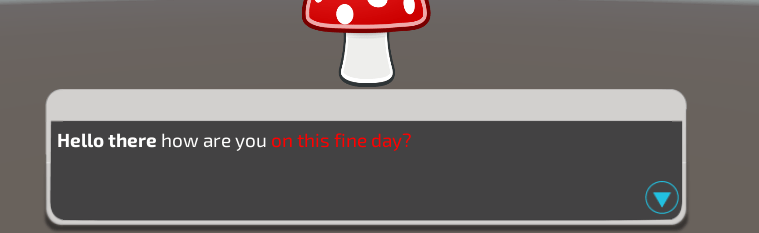
Looking into Fungus’s documentation, I can change the font’s size and colour and cause the textbox to shake, this is shown below in fig 1.
However, trying to recreate the effect where the words jitter is proving to be hard. Looking on their blog it shows you how to create a jitter effect on a specific word, but trying out their code shows no results, an example is shown below in fig 2 and 3.

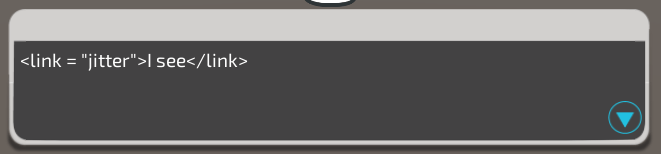
Due to the dates on their documentation it’s possible this solution is out of date and no alternatives have been shown, which has affected my hopes in using the effect in our team game (‘Blog’. sept 10, 20). Despite all this I will continue to look into this as I believe it will help add to the horror elements in the game.
Conclusion
In conclusion, I’ve continued to try out Hope’s techniques in dealing with my social anxiety, to help improve my communication, though it feels like some improvements have been made I should still continue, with the techniques for the rest of the week to see if more improvements can be made. The same can be said about my patience as it felt hard to stay still during the planning phase.
Next week we will be working on the game and will be using Fungus to create the dialogue system and mechanics, whether visual affects will be added to parts of the dialogue is unknown, however I will be continue researching tomorrow (Friday )to see if there is away to get them to work.
Bibliography
‘Blog’. sept 10, 20. Available at: https://fungusgames.com/blog. [Accessed Sep 30,].
WILTSHIRE, laex. 2019. ‘How Katana Zero Brought Action into Cutscenes’. Available at: https://www.rockpapershotgun.com/how-katana-zero-brought-action-into-cutscenes. [Accessed Sept 29].
HOPE, Debra A., Richard G. HEIMBERG and Cynthia L. TURK. 2006. Managing Social Anxiety: A Cognitive-Behavioral Therapy Approach Therapist Guide. Oxford University Press, Incorporated.
Figure list
Figure. 1: Max Oates. 2021. example of Fungu’s changing dialogue.
Figure. 2: Max Oates. 2021. example of the code for jittery words.
Figure. 3: Max Oates. 2021. example of jittery words not working.
 MaxMakesGamesBlog