Continuing from my last post, I’m starting my MSc AI for games to improve my knowledge in AI development. In this post I will be talking about the skills and themes that I think I will need to focus on during the masters.
What I want?
I want to really learn machine learning as it is at the frontier of the AI research and is used in business everywhere and as a programmer I want to understand how they work and how I could apply it to my own games and project. In addition, I believe it will help me get a job in both the games and software industry.
Over the masters I wish to focus on my communication skills as I struggled with Social Anxiety which occasionally makes talking to people difficult.
I also aim to focus on my planning skills specifically for programming projects as the way I designed systems and components has a times been very lacking causing me to have to revisit parts of my work to ensure that the project as a whole works properly.
Finally, the other skill I should focus on, is my patience as I have tendency to be very eager to start a project straight away which in turn has lead to a lack of system design and planning at times.
So what?
As mentioned earlier I want to improve my knowledge and skills with machine learning in order to appear more employable. As of my current knowledge and skill base, I believe that I don’t have enough and that by studying machine learning it would improve on them and add more interesting projects to my portfolio.
Struggling to communicate has made it difficult to get across my ideas or opinion about an idea to other people both in and outside of a team. This is likely due to self doubt and worrying that other around me are going to judge me for what I say.
Through experiences working in a team I have learned that it is good to have your voice heard – even if it does go against the goals of the project and makes you feel disruptive – when working in a team as it can ensure that you are not burning out.
After reading the second chapter about a book on social anxiety, though it’s in some ways sad to know Social Anxiety is the third most command psychiatric disorder at the same time it has given me some Solis knowing that it’s more common in than first thought (Hope et al. 2006).
Planning is a skill that I certainly have as I do need to plan out how the component will however, I believe that I don’t plan enough to the point where I can revisit the plan /design I have set out for myself and consider what potential tools I’ll need. Reflecting on the cause of this is partly due to my lack of patience and eagerness to start work on the project.
Reflecting on my patience when doing work, it likely stems from worrying about not having enough time to get everything done. This results in me rushing and avoiding planning causing me to make mistakes and perpetually continuing the cycle of worrying and rushing.
How will this change my work?
Looking into the future if I could improve these skills I believe that I would be much better as a programmer specialising in Artificial Intelligence (AI) and Gameplay. As I mentioned earlier I wanted to merge machine learning with games as I believe it could allow for more interesting and challenging enemy AI by changing their behaviors and through processes or machine learning could be used for procedural generation from the level design to weapon and item creation.
Looking at a book about leading teams and the confidence required for it, though it was about leading a sports team I believe that being confident around people would encourage me to work harder. In addition, if I could express that confidence to team members it could encourage others to work harder as well and give them a sense of security (Guenzi et al. 2013). Reading more of Hope’s book on Social Anxiety, potential ways to avoid triggering Social Anxiety is to identify automatic thoughts that come into your head and then challenge those thoughts to see that they are just worries that have much logic to them (Hope et al. 2006).
By planning out my work and being patience I would be a much better programmer as it would allow me to: anticipate bugs, see the scope of the project, avoid overlapping components and understand how components will interact with one another. Reading thought an article about planning programming projects I using flow charts and pseudocode is very good to use for planning it’s also suggested that I should have schedule and give myself deadline for features to be complete (Thelin 2020). An example of a flow chart is shown below in fig 1 .Using these techniques in my work would allow me to make more efficient components while ensuring the they are completed in a reasonable period of time.
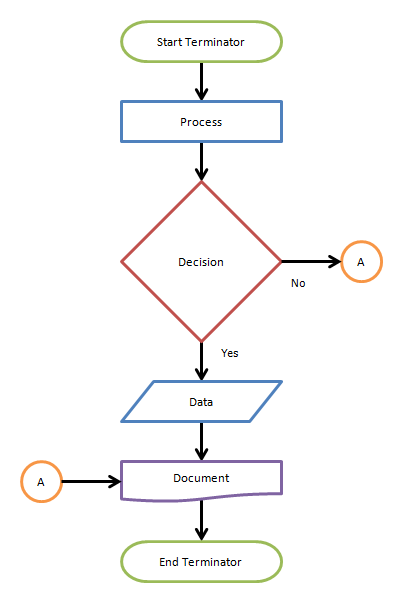
As for being more patience this could improve my work by allowing me moments to calm down and reflect on what might be the problem with the code or other parts of the project. In addition, being patient would allow me to give myself time to try out the techniques for my social anxiety thus improving my communication and patience all at once.
Conclusion
Reflecting on the skills I need to focus in order to better my work for masters has introduced me to interesting techniques to fight my anxiety and to improve myself with my planning and patience.
When using the techniques for my anxiety, I could begin by learning and recognising the signs of of it happening and then proceed to challenge the thoughts. When doing so I could give myself 5 minutes and if possible move to quite area to deals with them. I could try this once a day for a week and see if anything has improved when communicating. Ideally the goal would be able to deal with my anxiety on the fly while talking to people, incase it creeps up when talking or in a situation where leaving the room is out of the question.
As for my planning and concentration, when creating a flow chart for a game mechanic I should take 10 – 20 minuets to come up with the design showing how the system works. In addition, I should take breaks every hour where I walk away from the computer to relax for 5 minutes.
Hopefully by the end of my masters these skills will be improved.
Bibliography
GUENZI, Paolo, Dino RUTA, Paolo GUENZI and Dino RUTA. 2013. Leading Teams: Tools and Techniques for Successful Team Leadership from the Sports World. Somerset, UNITED KINGDOM: John Wiley & Sons, Incorporated.
HOPE, Debra A., Richard G. HEIMBERG and Cynthia L. TURK. 2006. Managing Social Anxiety: A Cognitive-Behavioral Therapy Approach Therapist Guide. Oxford University Press, Incorporated.
THELIN, Ryan. 2020. ‘How to Plan a Coding Project in 8 Easy Steps’. Available at: https://www.educative.io/blog/how-to-plan-a-coding-project. [Accessed Sep 22,].
Figure list
Figure 1. BreezeTree. 2021. No title. [diagram]. V&A [online]. Available at: https://www.breezetree.com/articles/what-is-a-flow-chart. [Accessed Sep 22,].
 MaxMakesGamesBlog