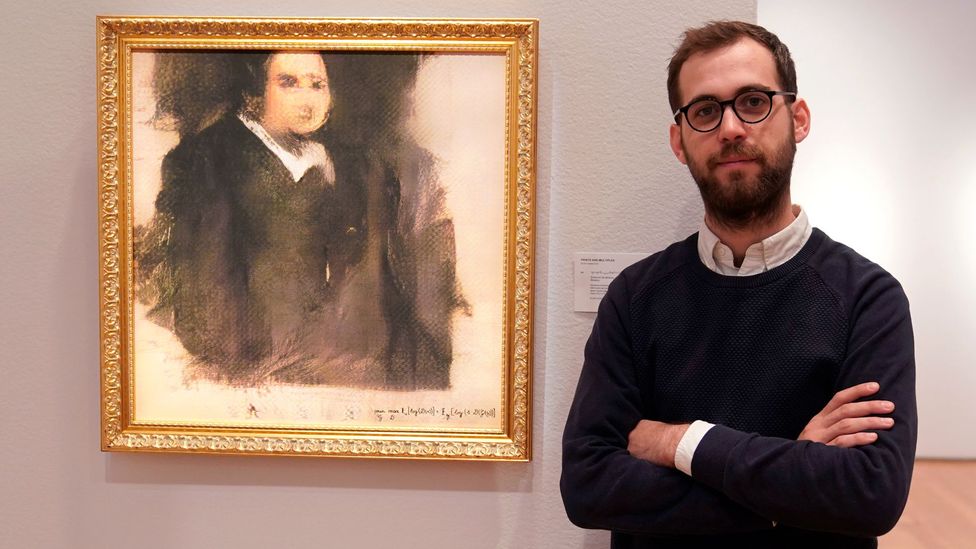
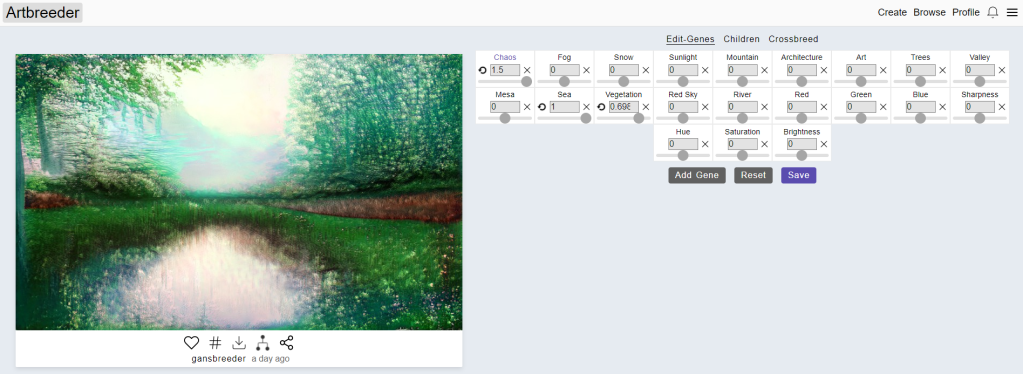
To start off my blog I’ve decided to talk about what was discussed in today’s lecture. We were discussing computational creativity (CC), a process where an AI displays behaviors that humans could recognise as being creative. Generally this would be generates novel pieces of art, music, poetry and etc (Mántaras. 2020). An example of Computational creativity is a portrait created by an AI that was trained with multiple paintings created by humans, this is show in fig 1(Graham 2018). Another example, is Artbreeder a website that uses AI to blend images together or use sliders to change parts of a picture this is show below in fig2. You can find Artbreeder via this link: https://www.artbreeder.com/browse
This is a type of AI that I am interested in as CC could be used as a game mechanic similar to procedural generation algorithms which are used to generate levels or items in video games (Short 2017). In addition, it could be used to create tools for making game development easier, making my dream of solo game development possible as tools like Procedural generation have been used in games like Skyrim (Bethesda 2011, PS3 ) to help artists build models of the world’s landscapes. However, one of the problems with letting an AI build you content is that they’re difficult to control and can easy give the user the type of content they don’t desire, this could partly be due to the element of randomness used in the content generation (Short 2017).
To achieve creating my own CC artefact I would need to develop my skills in AI programming, as though I have created AI artefacts in the past, they were created using classical AI techniques such as Finite State Machines or Behavior Tress, while the AI for CC can be trained with data, making it more advanced. A project like this would require patience, research, and planning to ensure that I fully understand how it works and so that I don’t get distraught if it takes longer to make and doesn’t work the first time.
Conclusion
At the end of the project I would have hopefully improved my hard skills in programming as well as my soft skills in patience and planning which in turn should make me a better programmer overall.
When researching creative computing, I had to be specific about what I was looking for and occasionally had to use terms like AI art or music and not use creative computing at all to find what I was looking for. In the future I will try to be specific about exactly what I’m looking for when researching topics.
If I tried to use computational creativity to creamy own artwork if would probably be discussed as to who has the rights to the artwork as thought I created the algorithm it was the thing that created the art work. In the future it is possible that law may need to be revisited to include AI as the sole owner of the art it makes.
To research this further I would spend 3 hours researching CC further and as mentioned earlier I would specific about the type of AI I was trying to make to ensure that there isn’t any misinformation. within those 3 hours I should have at least 10 reference to use in order to have a good understanding of how the systems to work and hot much data is required to train the AI.
Bibliography
GRAHAM, Thomas. 2018. ‘Art made by AI is Selling for Thousands – is it any Good?’. Available at: https://www.bbc.com/culture/article/20181210-art-made-by-ai-is-selling-for-thousands-is-it-any-good. [Accessed Sep 21,].
MÁNTARAS, Ramón López de. 2020. Artificial Intelligence and the Arts: Toward Computational Creativity.
SHORT, Tanya X. 2017. Procedural Generation in Game Design. CRC Press.
Skyrim. 2011. Bethesda Game Studios, Bethesda Softworks LLC
Figure List
Figure 1: Pierre Fautrel. 2018. Edmond de Belamie. [canvas print]. V&A [online]. Available at: https://www.bbc.com/culture/article/20181210-art-made-by-ai-is-selling-for-thousands-is-it-any-good. [Accessed Sep 21,].
Figure 2: Artbreeder. 2021.gansbreeder. [digital picture]. V&A [online]. Available at: https://www.artbreeder.com/browse. [Accessed Sep 21,].
 MaxMakesGamesBlog